
All Articles
Since the early days of the World Wide Web, Tim Berners-Lee’s vision of a "Semantic Web" has struggled with feasibility, acting as a digital Lego System where everyone was expected to build the exact same way. However, as a seasoned Web3 Architect, I do not believe we have yet experienced true Web3, but the technology to make it the most likely next iteration of the Web has finally arrived.
Listen to the Audio Version.
To understand this shift, we must distinguish two concepts: the Semantic Web (normalizing data to make its structure uniform and machine-readable) and Web3 (a distributed peer-to-peer communication network). While blockchain paved the way, Web3 has evolved into an umbrella term encompassing features like Peer-to-Peer networking, Sovereign Data, Personal AI, and Sovereign Custody.
The Core Pillars of the New Web
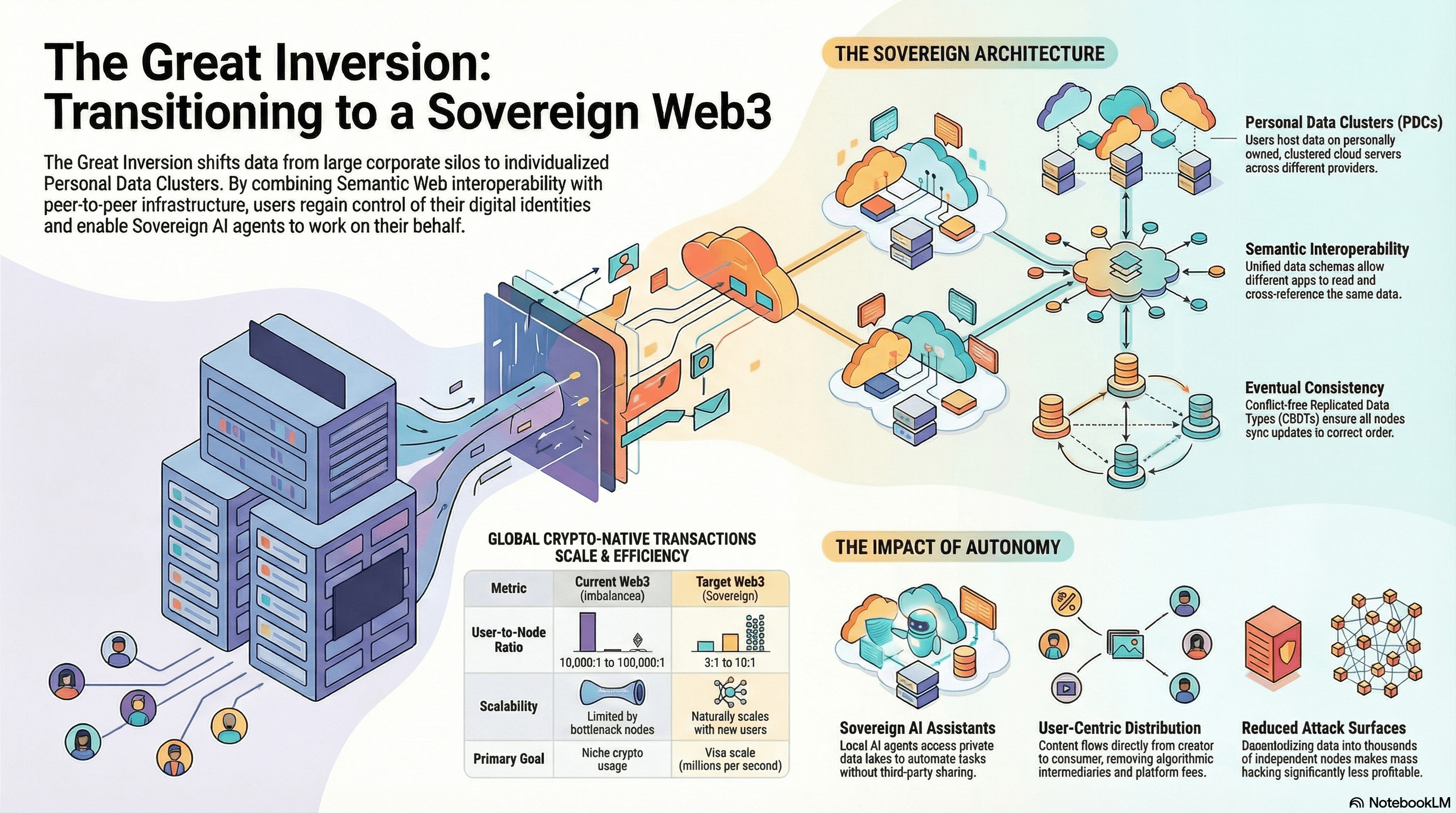
Peer-to-Peer and Sovereign Data: Moving away from intermediaries, Web3 utilizes protocols like IPFS and Content Addressing to share data efficiently across distributed networks. This enables the rise of consumer-grade Personal Data Clusters (PDCs)—personally owned cloud servers where users, not corporations, own and control the private keys to their data's encryption.
The Semantic Web and IoT: Centralized semantics combined with decentralized infrastructure means any device can communicate seamlessly. When your data shares interoperable schemas, it creates a much more useful web. It also paves the way for a crowdsourced Internet of Things, providing equitably accessible, independently verified sensor data to better respond to real-world events.
Personal AI and Sovereign Custody (The Great Inversion): Generative AI requires uninterrupted access to your data, and Web2's scattered databases are a less-than-optimal environment for this. The solution is re-centralizing your data into your own PDCs so your personal AI, or "digital twin," can securely optimize your life 24/7 without sharing your information with third parties. You literally become the master of your domain, dictating your own content algorithms and terms of service.
Decentralization, Crypto-Native, and Open Source: True decentralization is finally attainable. As users start running their own light nodes within their personal clusters, cryptocurrencies will naturally scale, likely rendering traditional transaction fees obsolete. This is entirely built upon an open-source foundation, utilizing immutable, append-only structures like Merkle Trees to track changes transparently.
Unprecedented Security and Inter-Planetary Scale: Web3 changes the economics of cyberattacks. By decentralizing data, we remove the massive third-party silos that attract hackers, making the web an order of magnitude more secure. Furthermore, by reducing bandwidth overhead through P2P content sharing, Web3 is the only viable architecture for the resource-limited realities of future space travel.
Conclusion
The inversion of Web2 is already in motion, promising a very challenging but exciting decade for digital infrastructure. I hope this inspires you to do your own independent research and ask yourself: Where is my data stored, and who owns my private keys?.
As the saying goes: "Not your keys, not your … anything."
Read the full article HERE.